

What Surfaces Can You Steam Clean? Safe and Unsafe List
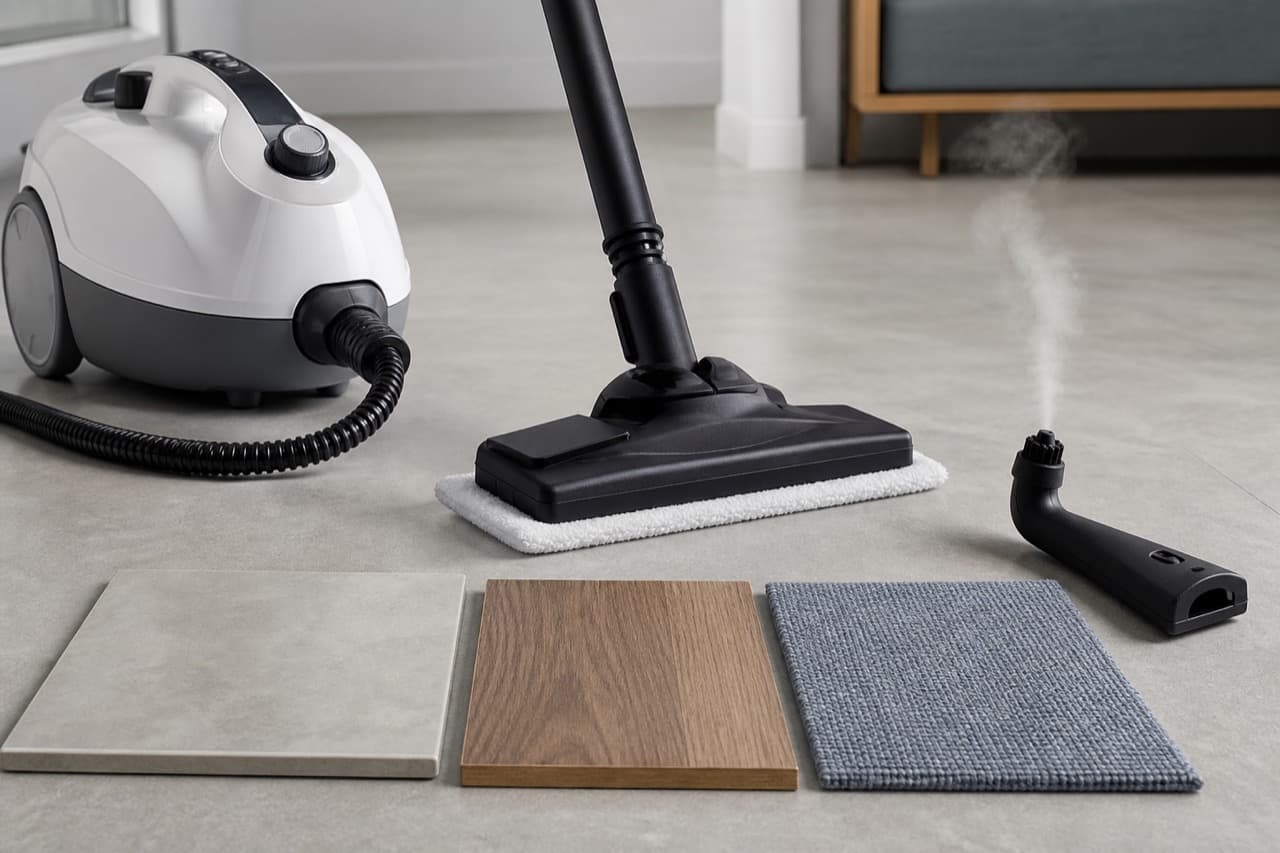
What surfaces can you steam clean? Hard, sealed, heat-tolerant materials such as glazed tile, stainless steel, chrome and glass usually cope well, while wood, laminate flooring, painted walls, unsealed stone, leather and electronics are the ones that warp, swell, peel or fail. This guide is for anyone with a handheld or small canister steam cleaner who wants to know where it is safe to point it before it leaves a mark that cannot be wiped off. For how to fill, heat and handle the unit safely, read our handheld steam cleaner safety guide; this article is about the surface on the other end.
Key takeaways
- Steam damages surfaces through heat, moisture and force. A material that tolerates only one of those three can still fail.
- Sealed, glazed or metal surfaces are usually safe. Porous, glued, laminated, painted or finished surfaces are the risk group.
- Always check the maker’s care instructions for the surface (flooring, countertop, upholstery tag) because they override any general rule.
- Patch-test in a hidden spot with a short burst, from a distance, before you clean a visible area.
- Keep the nozzle moving, wipe with a microfiber cloth, and never aim steam at outlets, switches, light fixtures or appliance controls.
- Steam loosens dirt and grease; it is not a substitute for a surface-specific cleaner on stone or finished wood.
Why steam damages some surfaces and not others
A steam cleaner heats water above boiling and delivers it as a hot, wet jet. Pressurized handhelds release steam that can be well above 212 degrees F (100 degrees C) at the nozzle, which softens grease and loosens dried-on grime. The same properties cause damage in four ways:
- Heat softens or discolors. Thermoplastics, resin-bound materials, paint and some adhesives soften or mark at temperatures steam easily reaches.
- Moisture swells. Wood, particleboard cores, laminate and paper-backed materials absorb water at seams and edges, then lift or cup as they dry.
- Thermal shock cracks. Cold glass, cold tile or an enameled surface heated unevenly can crack.
- Force strips finishes. A close jet blasts sealers, wax, loose grout or poorly bonded paint off the surface.
The difference between a safe and an unsafe surface is mostly the seal. A glazed tile sheds water and heat; unsealed stone, raw wood or the cut edge of a laminate board does not.
Surface by surface: usually fine, test first or avoid
Use the table as a starting point, then confirm with the manufacturer of your specific floor, countertop or fixture. It lists a general rule, not a guarantee for any particular product.
| Surface | Verdict | Notes |
|---|---|---|
| Glazed ceramic or porcelain tile | Usually fine | Good for floors, shower walls and backsplashes; keep the jet off damaged tiles where water can reach the substrate |
| Grout | Usually fine | Good for lifting soap scum and grease; repeated use can wear sealer, so reseal as needed, and avoid crumbling or cracked grout |
| Silicone caulk | Test first | Sound caulk usually tolerates a brief pass; old, lifting caulk may peel |
| Stainless steel sinks and appliances | Usually fine | Wipe dry to prevent water spots; avoid abrasive brushes on brushed finishes |
| Chrome and nickel faucets | Usually fine | Avoid peeling plating and lacquered brass |
| Glass and mirrors | Usually fine | Use at room temperature; skip very cold windows and any pane with a cracked edge or failed double-pane seal |
| Oven interior, stovetop, grill grates | Usually fine | Let heating parts cool; keep steam away from elements, fans and control panels |
| Sealed granite | Test first | Check the stone supplier; steam can wear sealer |
| Marble, limestone, travertine, unsealed stone | Avoid | Porous and easily dulled or stained; use a stone-safe cleaner |
| Engineered quartz countertops | Test first, often avoid | Resin binders can discolor under concentrated heat; follow the maker’s guidance |
| Laminate countertops | Test first | Short passes only; keep steam away from seams and edges |
| Hardwood and laminate flooring | Avoid | Moisture lifts boards and swells cores; most flooring makers advise against steam |
| Vinyl plank or sheet flooring | Test first | Adhesives and seams vary by product; check the flooring warranty first |
| Painted walls and wallpaper | Avoid | Paint softens or blisters; paper loosens |
| Upholstery and fabric | Check the tag | See the cleaning code below; velvet, silk and delicate weaves are poor candidates |
| Leather and suede | Avoid | Dries out, stains and shrinks |
| Plastic trim and car interiors | Test first | Many plastics soften or gloss; vinyl dashboards and thin trim are most at risk |
| Electronics, outlets, switches and light fixtures | Avoid | Water and electricity do not mix; do not steam near vents or ports |
Surfaces that need extra thought
Stone and quartz
Granite, marble and other natural stone vary a great deal. Sealed granite is often cleaned with a pH-neutral stone cleaner, and many stone suppliers do not recommend steam because it can wear the sealer. Marble, limestone and travertine are porous and soft, and steam can leave them dull or stained. Engineered quartz is mostly stone dust bound with resin, and countertop makers commonly warn against high heat. If you do steam a countertop, do it only after checking the supplier’s care sheet and testing a corner.
Wood, laminate and vinyl floors
These floors fail at their joints. Steam forces hot moisture into the tongue-and-groove seams, where cores swell, edges lift and finish clouds. Even sealed hardwood is typically excluded from steam-cleaning in the flooring maker’s care instructions. Vinyl plank is less consistent: some products tolerate a damp mop, but heat can soften the adhesive on glued-down floors. If you have a warranty, using steam against the care guide may void it.
Upholstery, mattresses and rugs
Look for the cleaning code on the furniture tag. W means water-based cleaning is acceptable, WS means water-based or solvent, S means solvent only, and X means vacuum only. Skip steam on S and X fabrics and on anything with a delicate finish. Soaking foam or a mattress core is a real risk, because moisture trapped inside can take a long time to dry and encourage odors. For rugs, check colorfastness and avoid wool, silk and anything with a glued backing.
Plastic and rubber
Appliance housings, car trim and children’s toys vary widely. Hard plastics may tolerate a quick pass, thin or textured plastics may gloss, warp or craze, and rubber seals can dry out when heated repeatedly. A short test from a distance tells you more than a general rule.
How to patch-test a surface
- Pick a hidden spot, such as the back of a cabinet, an inside edge, or a corner behind furniture.
- Vacuum or wipe loose dust first, so you are not turning grit into mud. A small cordless unit like those in our handheld vacuum buying guide is ideal.
- Hold the nozzle about 6 to 8 inches (15 to 20 cm) away and steam for two to three seconds with a cloth or the manufacturer’s recommended attachment.
- Wipe the spot, let it dry fully, and look at it in good light. Check for dulling, color change, bubbling, swelling, softness or a tacky feel.
- If nothing changed, repeat from closer range or for slightly longer, and check again after it dries. Stop at the first change.
- Clean the real area with the shortest contact time that works.
Technique that protects the surface
- Keep the nozzle moving. Dwell time is what turns a safe surface into a damaged one.
- Steam, then wipe. A microfiber cloth lifts the loosened soil; otherwise it dries back on.
- Choose the right attachment. A nylon brush works on grout and hinges; avoid metal bristles on chrome, enamel or glazed finishes.
- Do not use steam on surfaces that were recently painted, sealed or glued. Wait for the cure time on the product label.
- Ventilate the room and dry glass and metal so they do not spot.
- Treat steam as a cleaning aid, not as proof that a surface is disinfected, unless the maker specifically substantiates it for your model.
If you are shopping for a handheld unit, the Handheld High-Temperature Steam Cleaner is available on ADLTHUB; check the product page for tank size, attachments, specifications, delivery and returns. You can compare other cleaning tools in home and kitchen.
Mistakes to avoid
- Assuming sealed means steam-proof. Many sealers wear down under repeated heat, leaving stone and grout more vulnerable next time.
- Steaming a floor because the box says multi-surface. Flooring makers’ care sheets are what matter, and they often prohibit steam.
- Starting on the most visible spot. The first pass is the test, and it should be in a corner.
- Using it on cold glass or tile. A winter window or a chilled tile can crack under sudden heat.
- Holding the jet in one place. Concentrated heat is how paint blisters and plastic warps.
- Steaming near electrics. Outlets, switch plates and appliance panels stay dry.
Is steam the right tool for your surface?
- Pick steam for glazed tile, grout lines, stainless steel, chrome fixtures, oven glass and grill grates where grease and soap scum are the problem.
- Pick a damp microfiber cloth and a pH-neutral cleaner for natural stone, quartz and finished wood.
- Pick a vacuum and a lightly damp mop for laminate and hardwood floors, following the flooring maker’s instructions.
- Pick a fabric-safe cleaner or professional service for upholstery with an S or X code.
- Skip steam altogether on painted walls, leather, electronics and anything you cannot test first.
Frequently asked questions
Can you steam clean laminate floors?
Most laminate flooring manufacturers advise against it. Hot moisture can enter the seams and swell the fiberboard core, and the damage is permanent. Check the care instructions for your floor, and use a lightly damp microfiber mop instead.
Is it safe to steam clean grout?
Yes, steam is widely used on sound grout lines, and it loosens soap scum and grease well. Repeated use can wear grout sealer, so plan to reseal, and avoid steaming cracked or crumbling grout where water can reach the layer beneath.
Can you steam clean granite or quartz countertops?
It depends on the product and the maker’s guidance. Many suppliers recommend pH-neutral stone cleaners over steam, and quartz contains resin that can be sensitive to heat. Check the care sheet and test an inconspicuous corner, or skip steam on countertops.
What should you never steam clean?
Skip hardwood floors, laminate flooring, painted walls, wallpaper, leather, unsealed or soft natural stone, electronics, outlets and light fixtures. Also avoid cold glass and anything with a damaged finish or a missing seal.
How far should the nozzle be from the surface?
For a test, start about 6 to 8 inches (15 to 20 cm) away and move closer only if the surface shows no change after drying. For general cleaning, follow the attachment guidance in your manual and keep the nozzle moving.
Shop Home & Kitchen
View all →
3-Tier Over-Toilet Storage Rack in Powder-Coated Carbon Steel
In stock · Options available · Ships in 7–21 business days
 Sale
Wingback Massage Recliner Chair in PU Leather with Footrest
In stock · Options available · Ships in 7–21 business days
 Sale
Mid-Century Modern Accent Armchairs, Set of Two, Wood Frame
In stock · Options available · Ships in 7–21 business days

Fireplace Flame Ultrasonic Humidifier and Oil Diffuser
In stock · Options available · Ships in 7–21 business days
Continue reading
 Home & Kitchen
Burr Grinder Cleaning and Calibration: Deep Clean and Re-Zero
A burr grinder cleaning routine beyond a quick brush: removing burrs, clearing the chute, finding zero again, checking alignment and spotting burr wear.
 Home & Kitchen
Handheld Steam Cleaner Safety: Burns, Refills and Use
Handheld steam cleaner safety explained: how to fill, heat, refill and store a pressurized steamer, avoid burns and electrical risks, and know when to stop.
 Home & Kitchen
How to Clean an Essential Oil Diffuser Step by Step
How to clean an essential oil diffuser: weekly vinegar descaling, safe care for the ultrasonic plate, nebulizer cleaning, and daily habits that stop residue.