

LED Makeup Mirror Lighting: CRI, Color and Brightness
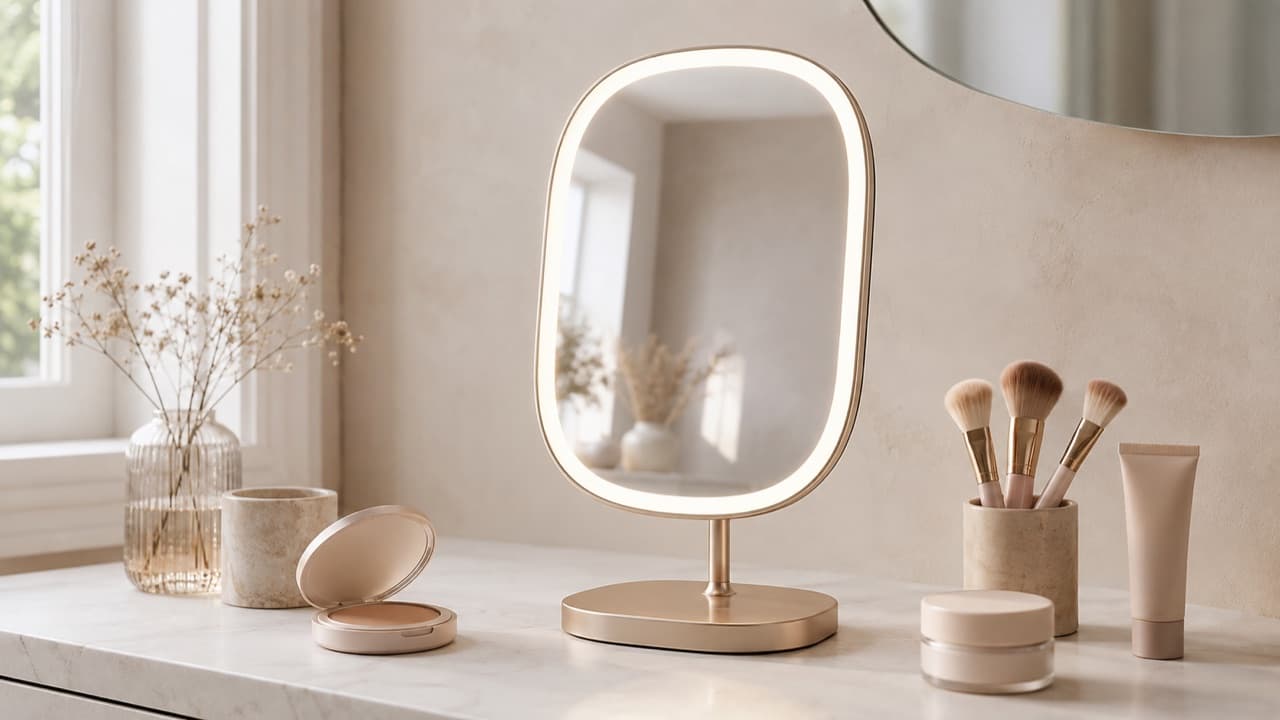
Good LED makeup mirror lighting does two jobs: it lights your face evenly from the front, and it renders skin tones close to how they will look in daylight. If a mirror gets those two things right, foundation matches, blush stays believable and brows look the same in the car as they did at the vanity. This guide is for anyone choosing a lighted vanity or tabletop mirror, or trying to work out why makeup that looked perfect at home looks wrong outdoors. The short version: prioritize a high color rendering index (CRI), adjustable color temperature and lights that surround the face rather than sit above it. Magnification and smart features come second.
Key takeaways
- Look for a stated CRI of 90 or higher. Below that, reds and skin undertones can look dull or shifted, which makes shade matching harder.
- Adjustable color temperature (roughly 3000K warm to 5000K-6000K cool) lets you check makeup in the light you will actually be seen in.
- Light that wraps the face from the sides or a full ring beats a single bar above the mirror, which casts shadows under brows, nose and chin.
- Use 5x or 7x magnification only for detail work such as liner and brows; do base makeup in a 1x mirror so you judge blending at a normal distance.
- Check the power source before you buy: plug-in mirrors hold brightness, while battery and USB models may dim as charge drops.
Why CRI matters more than brightness
Color rendering index is a 0-100 score describing how faithfully a light source shows colors compared with a reference light such as daylight. Cheap LEDs often hit a high brightness with a CRI in the low 80s, which is fine for a hallway but weak for makeup. Low-CRI light tends to under-render deep reds, the part of the spectrum that gives skin its warmth, so foundation can look gray or flat and you compensate with too much bronzer or blush.
When a listing states “CRI 90+” or “CRI 95,” that is the number to compare. Some manufacturers also publish R9, the specific score for saturated red; a positive and reasonably high R9 is a good sign, though few consumer mirrors list it. If a listing says nothing about CRI at all, assume it is ordinary and treat the mirror as a convenience light rather than a color-matching tool.
Brightness still matters, just less than people expect. You want enough light that your pupils do not have to work hard and fine texture is visible, but a mirror that blasts you at full power will wash out contour and make you apply heavier. A dimmer with several steps, or a stepless touch control, is more useful than a high maximum output.
Choosing a color temperature for makeup
Color temperature, measured in kelvin (K), describes whether white light looks warm or cool. Lower numbers are warmer and more yellow; higher numbers are cooler and bluer. Most adjustable mirrors offer three presets, typically around 3000K, 4000K and 5000K-6500K.
| Setting | Typical range | What it simulates | Use it to check |
|---|---|---|---|
| Warm | 2700K-3000K | Home lamps, restaurants, evening events | How evening makeup reads under dim, yellow light |
| Neutral | 3500K-4500K | Offices and many retail spaces | Everyday work makeup; a balanced default |
| Cool / daylight | 5000K-6500K | Daylight and overcast outdoor light | Foundation match, concealer and any visible lines of demarcation |
A practical routine is to apply under neutral light, then switch to daylight to check your jawline and hairline before you leave. If you do makeup for an evening event, a final look under warm light shows whether highlighter and blush will still register. A mirror with a single fixed color temperature forces you to guess, which is why adjustable models are worth the small premium.
Light placement: ring, side strips or top bar
The geometry of the light matters as much as its quality. Light coming from directly above creates shadows in the eye sockets and under the nose and jaw, which makes you think you need more concealer than you do. Light coming from the front and both sides fills those shadows and shows your face the way people usually see it in conversation.
- Full ring or frame of light: the most even option. Works well for tabletop mirrors used at arm’s length.
- Vertical strips on both sides: the classic dressing-room approach. Very even across the face if the strips run at least from forehead to chin height.
- Hollywood-style bulbs around the frame: attractive and even, but individual bulbs can create bright points that reflect in the eyes; frosted bulbs help.
- Single top bar: the weakest choice for makeup. Fine as supplementary light, not as the only source.
Room lighting still plays a part. A strong ceiling light behind you or a bright window to one side will fight the mirror and create uneven cross-lighting. If your vanity sits next to a window, try to face the window rather than having it beside you. For ideas on positioning fixed lights in a bedroom or dressing area, see our wall light placement guide.
Magnification, size and mounting
Magnifying mirrors shorten your working distance, so they are useful for precise tasks and frustrating for everything else. A 1x surface is where you judge overall balance. A 5x or 7x insert or secondary mirror is enough for liner, lash glue and brow grooming for most people. 10x and above shows extreme detail but has a very short focal distance and a tiny field of view, which makes it awkward for anything except tweezing.
Many good setups pair a double-sided tabletop mirror (1x on one side, 5x or 7x on the other) with a removable small magnifier that sticks to the main glass. For size, a main mirror around 10-14 inches (25-35 cm) wide lets you see your whole face and hairline at a comfortable distance; larger vanity mirrors show shoulders and hair too, which helps when styling.
Mounting options trade flexibility against counter space. Tabletop mirrors move wherever the best light or outlet is. Wall-mounted extending arms free the counter but need a solid wall anchor and, for hardwired models, an electrician. Travel mirrors fold flat and usually run on a built-in battery charged by USB.
Power, safety and care
Plug-in mirrors keep a steady output and are the better choice for a permanent vanity. Battery and USB-rechargeable models are convenient, but check whether brightness drops as the battery runs down and how long a charge lasts at the setting you use. If you plan to use one in the bathroom, keep the plug, cord and any charging port away from the sink, and follow the manufacturer’s guidance on humidity; most tabletop mirrors are not designed to be splashed. Hardwired bathroom fixtures must be installed to local electrical code by a qualified person.
LEDs themselves run cool, but some cheaper drivers flicker at low dimming levels, which can be tiring during a long session. If a mirror visibly flickers or strobes when dimmed, or a phone camera shows heavy banding, that is a reason to return it. For cleaning, switch it off, then wipe the glass with a soft microfiber cloth lightly dampened with glass cleaner sprayed on the cloth, never directly on the mirror, so liquid does not seep behind the glass or into the LED strip. Keep makeup brushes and powders off the light diffuser; pigment dust builds up and dims output over time. Our makeup brush types and care guide covers keeping the tools at that station clean too.
Mistakes to avoid
- Buying on lumens or “super bright” claims alone. A bright, low-CRI mirror still misrepresents skin tone; you will just see the wrong color more clearly.
- Doing all your makeup in magnification. At 5x or more you blend for a distance no one views you from, which tends to produce heavy, patchy results at normal distance.
- Applying in cool light only. Daylight settings are excellent for checking a match, but if you only ever look at 6000K you may be surprised by how flat makeup looks under warm evening light.
- Ignoring the room behind the mirror. A bright window to one side or an overhead spotlight creates uneven shadows that the mirror cannot cancel out.
- Overlooking the power cord length and plug type. A mirror that only reaches the outlet by sitting next to a wet sink is a poor setup.
How to choose the right lighted makeup mirror
Pick a plug-in tabletop or vanity mirror with CRI 90+, three or more color temperature settings and side or ring lighting if you do full-face makeup daily and care about shade matching. Pick a compact rechargeable mirror with a 1x/5x split if you need something for travel or a small apartment where the mirror moves between rooms; accept that it will be less even. Pick a wall-mounted extending mirror with magnification if your counter is crowded and you mainly need it for grooming, brows or contact lenses. If you are building out a full routine, browse our personal care collection and read our comparison of synthetic vs natural makeup brushes before choosing tools to go with the mirror.
Frequently asked questions
What color light is best for doing makeup?
A neutral to daylight color temperature, roughly 4000K-5500K, with high CRI is the most reliable for applying and matching makeup. Check the result under warm light as well if you are going somewhere lit by lamps or candles.
Is a 10x magnifying mirror too strong for makeup?
For most makeup it is. 10x makes the focal distance very short and the visible area tiny, so it suits tweezing and close detail; 5x or 7x is usually enough for eyeliner and lashes, with base makeup done at 1x.
What does CRI 90 mean on a vanity mirror?
It means the light renders colors with a score of 90 out of 100 against a reference source, which is considered good for color-critical tasks. Higher is better, and listings that omit CRI usually use ordinary LEDs in the low 80s.
Why does my makeup look different outside?
Daylight is cooler and far more intense than most indoor light, and it comes from many directions. Makeup applied under warm, low-CRI light from above often looks too orange, heavy or uneven outdoors, so check it on a daylight setting before you leave.
Can I use an LED makeup mirror in the bathroom?
Many people do, but keep it away from splashes and follow the manufacturer’s instructions on humidity and placement. Plug-in models should be kept clear of the sink, and hardwired bathroom mirrors should be installed by a qualified electrician.
Shop Beauty & Personal Care
View all → Sale
SaleChampagne Gold Makeup Brush Set with Travel Pouch
In stock · Options available · Ships in 7–21 business days
Tourmaline Ceramic Hair Curler with Adjustable Heat
In stock · Options available · Ships in 7–21 business days
 Sale
SaleRotating Hot Air Brush with Ceramic Tourmaline Barrel
In stock · Ships in 7–21 business days
 Sale
SaleHigh-Speed Brushless Ionic Hair Dryer with Magnetic Nozzle
In stock · Options available · Ships in 7–21 business days
Continue reading
 Beauty & Personal Care
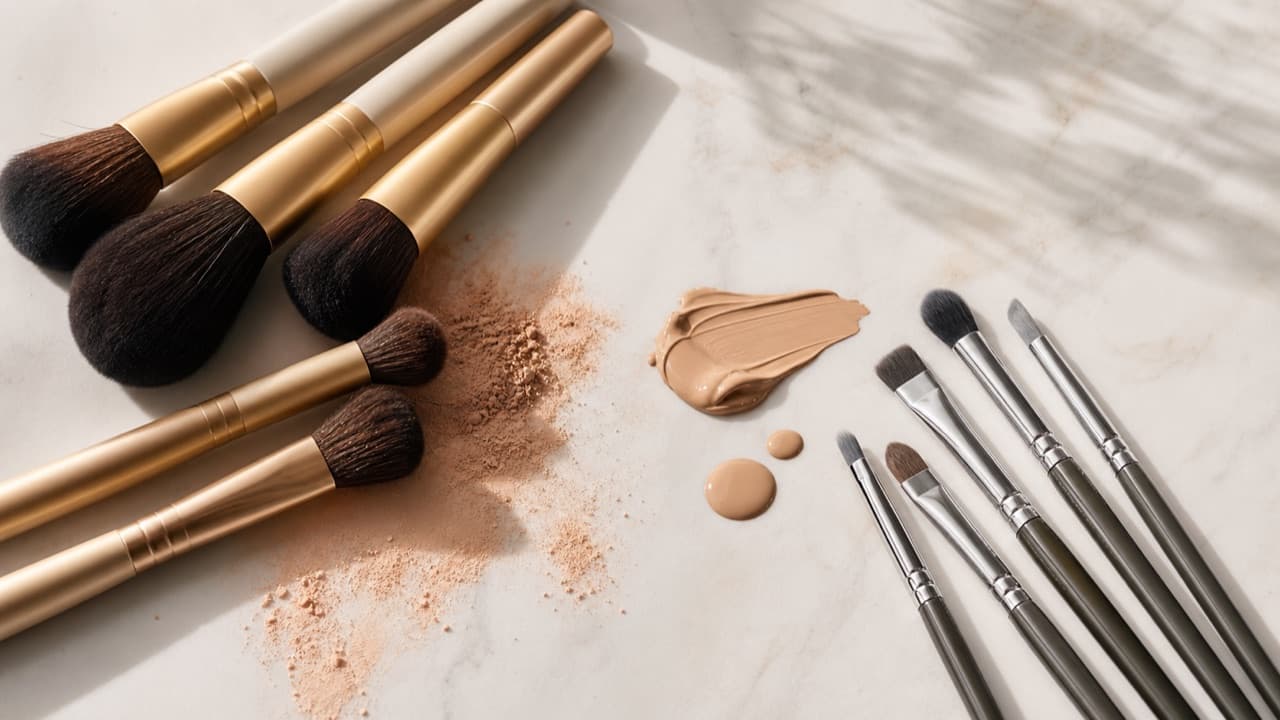
Synthetic vs Natural Makeup Brushes: Which Should You Buy?
Synthetic vs natural makeup brushes: how each bristle type handles powder, cream and liquid, how to wash them, and which to buy for face and eye makeup.
 Beauty & Personal Care
Makeup Brush Types and Uses, Plus How to Clean Them
Makeup brush types and uses explained by shape and density, with a simple cleaning schedule, drying method and signs a brush needs replacing.
 Beauty & Personal Care
Face and Body Sunscreen: SPF, Amount and Reapplication
How to choose face and body sunscreen: what SPF and broad spectrum mean, how much to apply, water-resistance labels, mineral vs chemical filters and textures.